
F.C.M.B. v. Abdul Gafaru & Co. Ltd. (2026) 6 NWLR (Pt. 2038) 179: Corporate Personality, Damages, Interest and the Limits of Reliefs to Non-Parties.
The case of F.C.M.B. v. Abdul Gafaru & Co. Ltd. (2026) 6 NWLR (Pt. 2038) 179 is a case decided by the Supreme court of Nigeria during which some fundamental issues of law has been decided from how an artificial legal entity is incapable, unfit and
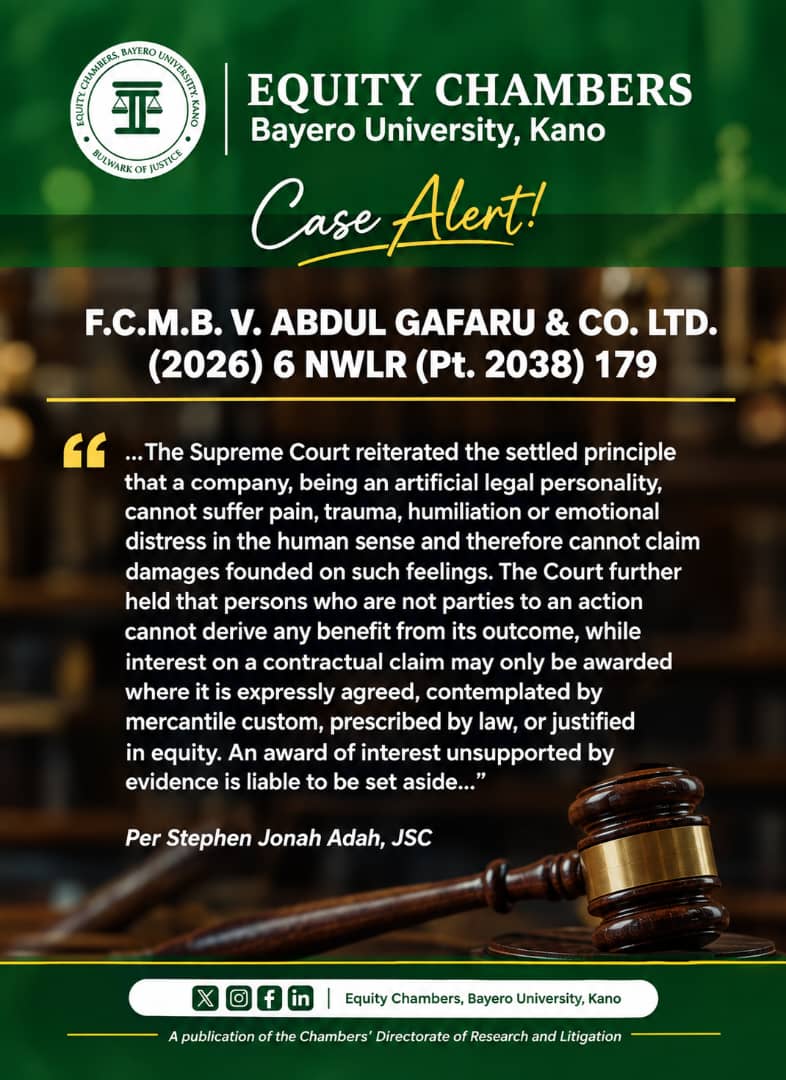
unqualified of experiencing trauma, embarrassment and with this can't claim an emotional damages to how an award of interest on claims rooted in contract can be properly awarded to the principle of law that people who are not parties to a suit cannot derive any benefit from it's outcome.
Before dwelling into the ocean of the analysis of the case, looking at the brief statement of fact will help in understanding how the case came to be
BRIEF STATEMENT OF FACT
The 1st respondent obtained an arbitral award against the Federal Government of Nigeria and enforced it via garnishee proceedings at the Federal High Court. A garnishee order was made against funds in the Consolidated Revenue Fund held by the CBN, which consequently transferred ₦3,040,094,393.57 to the appellant. Pending confirmation, the funds were placed in an interest yielding account, earning ₦6,802,834.18 interest. On 11th November 2008, the appellant credited the 1st respondent with both sums. The 1st respondent withdrew ₦1,321,097,410, leaving a balance of ₦1,718,996,983.16.
The Attorney General of the Federation then directed the appellant to freeze the balance and recover released funds, citing non compliance with Section 84 of the Sheriffs and Civil Process Act. The appellant complied, placed a Post No Debit restriction on the account, and remitted the balance to the CBN. After verifying the judgment debt, the AGF subsequently authorized payment of the verified sum to the 1st respondent.
Meanwhile, following the imposition of the Post no debit restriction, the respondents instituted an action against the appellant at the High Court by which it claimed some reliefs and the trial court ruled in favour of the respondent.
The appellant further appeal to the Court of Appeal which was dismissed and on further appeal to the Supreme Court, the appellant failed to tie its second ground of appeal to any issue for determination.
However the Supreme Court considered the provisions of section 22 of the Supreme Court Act, which provides: The Supreme Court may, from time to time, make any order necessary for determining the real question in controversy in the appeal, and may amend any defect or error in the record of appeal and.
Two issues were raised from the grounds of appeal;
1. Whether having regard to the settled position of law, the pleadings and the lawful evidence before the trial court, the lower court rightly affirmed damages awarded by the trial court in favour of the respondent and if so, whether the amount awarded was not excessive?
2. Whether the Court of Appeal was right in affirming the decision of the trial court to the effect that the interest to be awarded is at the rate of 18% and on the basis of the whole initial deposit of ₦3,040,094,393.57.
Before going fully into the judgement of the case, one vital issue was raised which is that ground 2 of the notice of appeal of the appellant was not tied to any issue and it has been firmly established that in our law that a ground of appeal not argued in the brief is deemed abandoned and liable to be struck out and this led to the struck out of the ground 2 of the appellant.
From the issue 1 on whether having regard to the settled position of law, the pleadings and the lawful evidence before the trial court, the lower court rightly affirmed damages awarded by the trial court in favour of the respondent and if so, whether the amount awarded was not excessive? The court held that directors who are not parties to a suit cannot derive any benefit from its outcome. The lower courts were therefore in clear error when they awarded general damages in favour of the persons who were not parties to the proceedings.
Furthermore, the apex court held that the respondent are all limited liability companies and it's trite that a company, upon incorporation, becomes a separate legal entity distinct from its shareholders and directors, enjoys perpetual succession, and continues to exist despite changes in ownership or management.
However, it should be noted that the Directors are its human managers but they are distinct and separate from the personality of the company. The respondent who were the plaintiffs, being registered companies are not natural persons with body, mind, feelings or emotions. Therefore, they cannot suffer pain, humiliations, trauma or emotional distress in the human sense. They, as companies can claim other pecuniary or propriety damages but not anything that has to do with feelings and emotions. This is apt because they are artificial personalities without flesh, blood and soul.
Going on, the SC clearly stated what a claim of interest is which is a monetary demand made by a claimant for compensation to cover the time value of money between when the cause of action arose and when the judgment is given or satisfied. However the interest of claim can be claimed and be properly awarded in the following situations;
1. Where it is expressly agreed upon by the parties.
2. Where contemplated in the agreement between the parties, under a mercantile custom.
3. Where it is prescribed by law, substantive or procedural.
4. Where it is equitable such as in a fiducial relationship between parties.
In the instant case, the appellant paid 7% interest (₦6,802,834.18) on 11/11/2008, yet the lower courts still awarded 20% interest from 30 October to 5 January 2009 ignoring the 13 days already paid. The respondents also failed to prove their 20% claim with evidence. The court held the order was perverse, unsupported by facts, which occasioned a miscarriage of justice, and the order is therefore null and void.
In conclusion, the judgement of the apex court is appalling as it reiterated the already established principle of law that a legal entity is incapable, unfit of experiencing trauma, embarrassment or emotional distress and with this cannot claim for emotional and personal suffering damages. Also, it is established that in law before an award of interest of claim rooted in contract can be properly awarded out in our jurisprudence some situations must however arise. And lastly, the case hammered on the well established principle of law that people who are not parties to a suit cannot derive any benefit from its outcome.
________________
Khalid Adediran Taofiq is a Level 200 student of the Faculty of Law, Bayero University Kano, and a member of the Directorate of Research and Litigation, Equity Chambers.